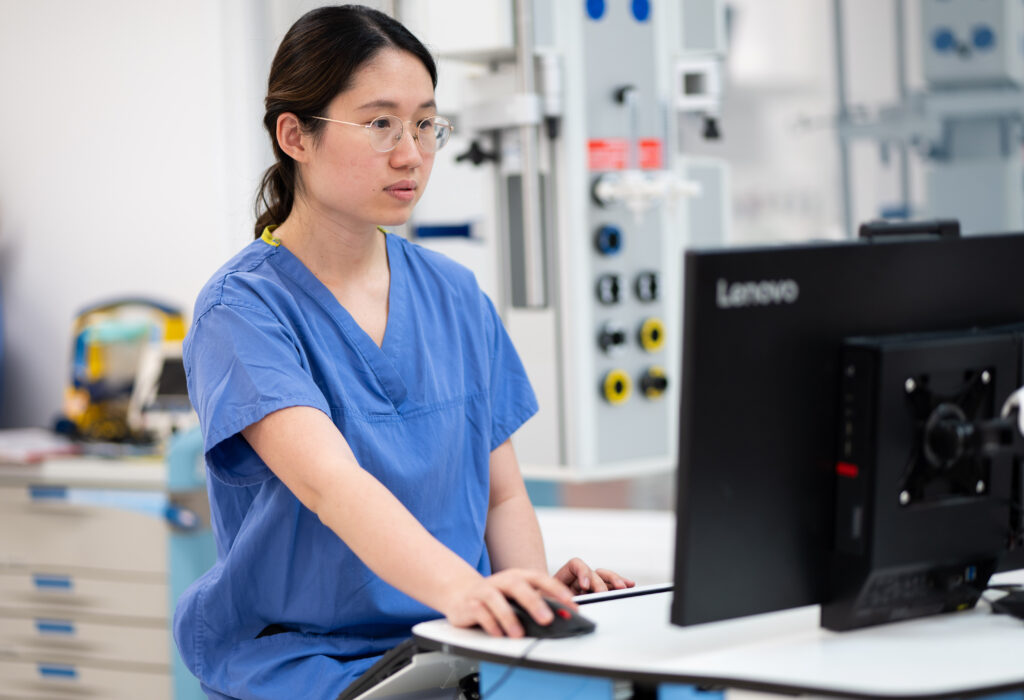
Medical physicist
Medical physicists contribute to the diagnosis and treatment of patients as part of a multi-disciplinary team. They work with X-rays, CT scanners, MRI machines and other medical imaging technology. Medical physicists are responsible for developing, implementing and ensuring the safety of this technology. Medical physicists also work with oncologists to plan radiation therapy treatment for cancer patients. They ensure the safety and effectiveness of medical imaging equipment and provide expert advice on radiation protection for patients and staff in accordance with legislation. Medical physicists also provide training to healthcare staff on the use of new medical imaging equipment and safe practices.
To become a medical physicist, you will need a BSc in Healthcare Science, specialising in radiation physics or radiotherapy physics. After achieving your degree, you will need to apply to the NHS Scientist Training Programme where you will study towards a master’s degree in clinical science and specialise in medical physics. You can also apply for the Healthcare Science Practitioner Level 6 degree apprenticeship.
For further information, visit National Careers ServiceNuclear medicine technologist
Nuclear medicine technologists are healthcare scientists who use radioactive materials and medical imaging equipment to help diagnose and treat diseases in patients. They will have knowledge of physics, chemistry and biology. Manual dexterity is important as technologists will handle radioactive materials. They prepare and administer radioactive tracers, operating equipment such as a gamma camera, and then process the images using computer software. Nuclear medicine technologists are part of the multi-disciplinary imaging team and work and ensure the safety of both patients and colleagues while working with radioactive materials.
You can train solely as a clinical technologist by undertaking a BSc in Clinical Technology, specialising in nuclear medicine during your degree. Alternatively, you can first train as a diagnostic radiographer by undertaking a BSc in Diagnostic Radiography and then specialise in nuclear medicine by undertaking a postgraduate qualification.
For further information, visit the British Nuclear Medicine SocietyRadiology nurse
Radiology nurses are registered nurses who specialise in patient care during interventional radiology procedures, which may involve image guidance such as CT scans, fluoroscopy and ultrasound. Their role includes managing patient care, administering medications, undertaking physiological measurements and patient observations and addressing any complications.
Radiology nurses are expected to have a detailed understanding of imaging modalities.
To become a radiology nurse, you will undertake a BSc in Nursing or a Nursing degree apprenticeship. Upon completion, you will register with the Nursing and Midwifery Council. On gaining your general nursing experience, you can then explore opportunities to work in radiology departments, where you can consider additional qualifications relevant to the role.
For further information visit the Nursing and Midwifery Council