
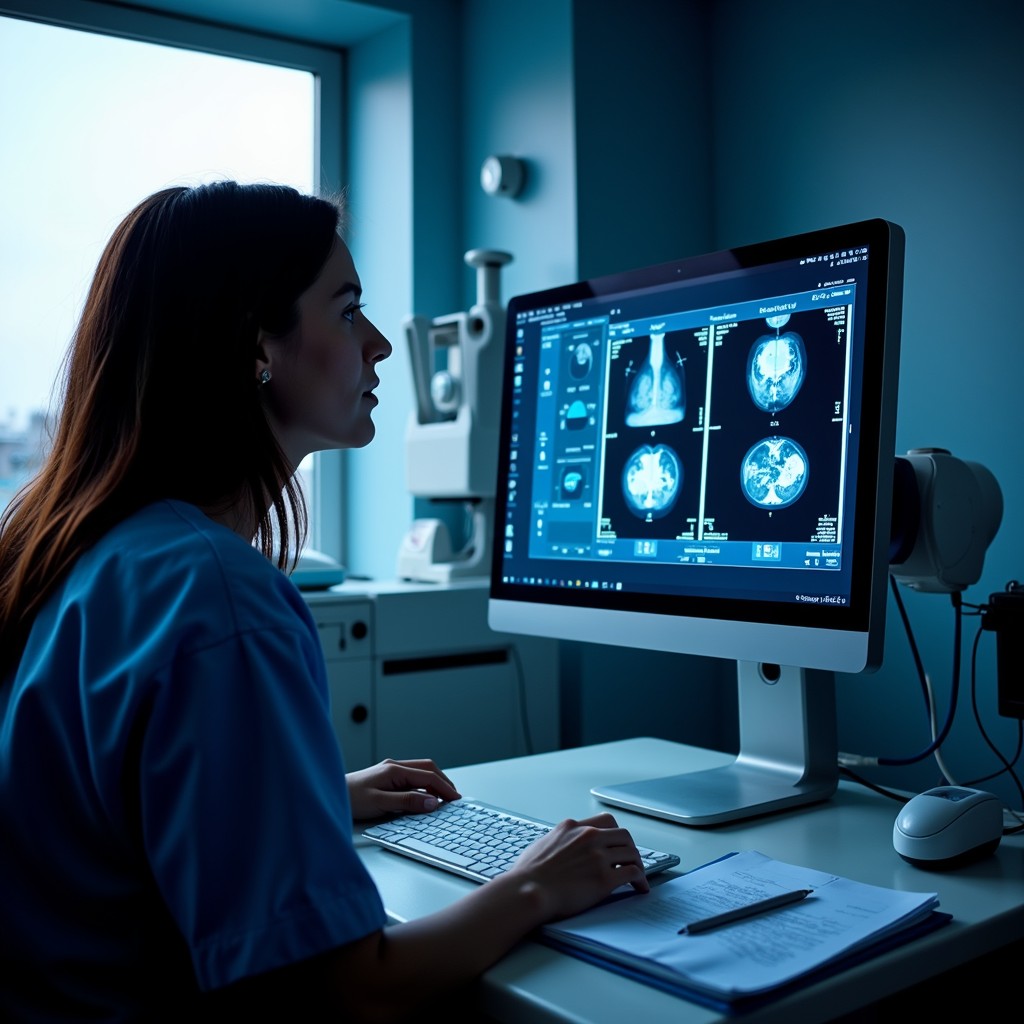
A consultant radiologist is a medical doctor who specialises in diagnosing and guiding the treatment of illnesses using imaging techniques such as X-rays, CT scans and MRIs. You will examine the anatomy, pathology and clinical history of a patient to inform your diagnosis, working as part of a multi-disciplinary team.
Becoming a consultant radiologist involves completing a medical degree and a two-year foundation programme, followed by a minimum of five years of specialist training in clinical radiology.
Radiology sub-specialities
Once you begin your radiology career, a wide range of exciting sub-specialties becomes available. See the specialities below to learn more:
Uroradiology
Involves all imaging modalities and offers both diagnostic and interventional opportunities – like nephrostomies and renal tumour ablation. Close collaboration with urologists, oncologists, and nephrologists. Great for those who enjoy multidisciplinary teamwork and ongoing patient care.
Gastrointestinal (GI) Radiology
A broad and evolving field covering cross-sectional imaging, fluoroscopy, and even endoscopy. GI radiologists work closely with gastroenterologists, surgeons, and oncologists, often in acute and trauma settings. A versatile subspecialty with excellent career flexibility.
Radionuclide Radiology & Nuclear Medicine
Combines structural and functional imaging, with a growing role in PET-CT, SPECT-CT, and dementia imaging. The Peninsula offers training up to dual accreditation. A high-demand, cutting-edge specialty with national importance.
Chest Radiology
Covers all imaging modalities for the lungs, pleura, and mediastinum. Includes key techniques like high-resolution computed tomography (HRCT), CT pulmonary angiography, and functional imaging. Crucial in diagnosing common and serious conditions like interstitial lung disease (ILD), pulmonary embolism (PE), and cancer.
Cardiac Radiology
The fastest-growing subspecialty, driven by advances in CT and MRI. Strong clinical impact and collaboration with cardiology. Peninsula resident doctors receive leading-edge training and opportunities for international placements and research.
Neuroradiology
Focuses on imaging and intervention of the brain, spine, skull base, and ear, nose and throat (ENT). Involves cutting-edge techniques like MR spectroscopy and endovascular treatment of aneurysms. Significant clinical involvement and growing role in stroke management.
Interventional Radiology (IR)
A dynamic field that delivers minimally invasive, image-guided treatments – crucial in trauma, oncology and vascular care. IR demands strong spatial skills and offers high-impact clinical outcomes. Includes emergency and elective procedures.
Musculoskeletal (MSK) Radiology
Involves static and dynamic imaging of bones, joints, and soft tissues. Strong focus on interventional procedures like joint injections and nerve blocks. Extensive clinical interaction, particularly in sports medicine and orthopaedics.
Ultrasound
A core tool in many specialties, often the first-line imaging modality. Training includes diagnostic use across multiple systems, guided procedures (fine needle aspiration, biopsies), and contrast-enhanced ultrasound. Useful in women’s health, gastrointestinal, genitourinary and head & neck imaging.
Breast Radiology
A highly patient-facing specialty combining mammography, ultrasound, MRI, and intervention. Key in screening and diagnosis, often managing the full patient pathway. Breast radiologists are in demand, with strong job prospects.
For further information, visit:
NHS Careers